Step 1 · Topic
The “five fifths”
At the top of the segmentation, five groups without their own chief, whose essential function was to provide, in turn, the chief of all.
Guided tours · 10 steps
How the confederation was organised: the five fifths, one after another, then what held them together: the supreme chief, Igherm Amazdar, justice and pacts.
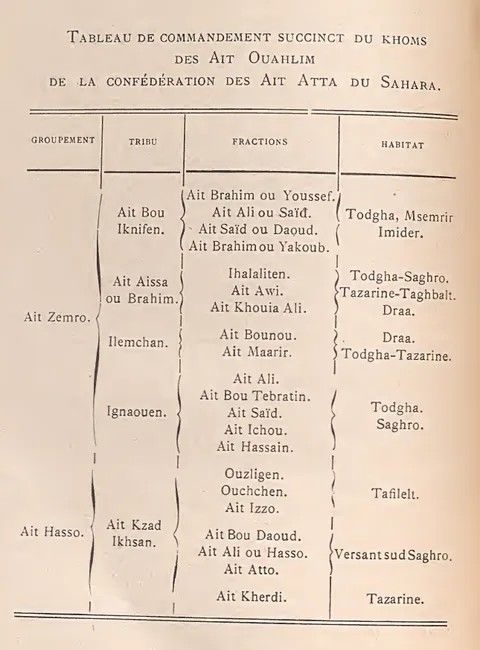
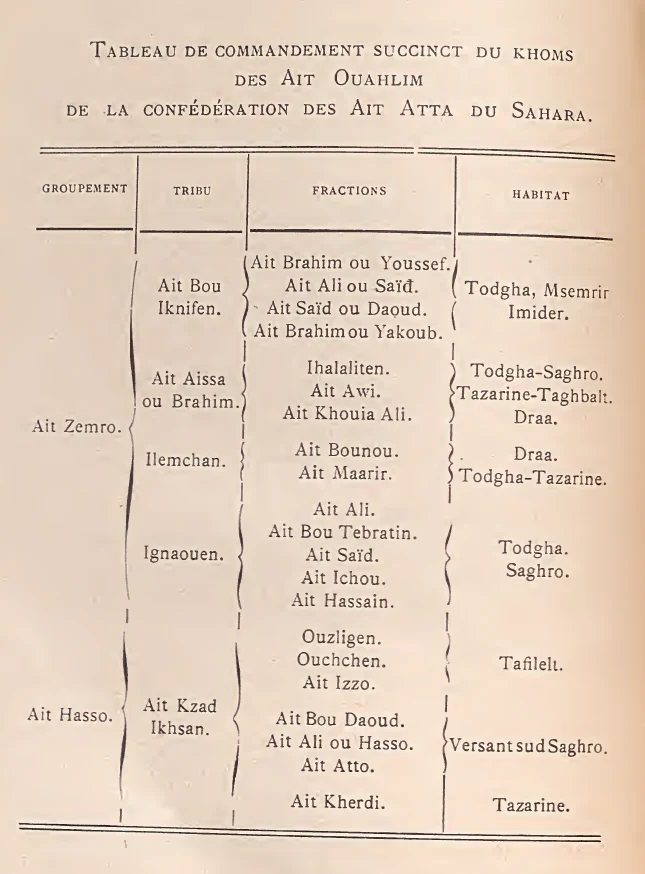
Table of the khoms of the Aït Ouahlim (Lieutenant Beaurpère, 1930) — Villes et tribus du Maroc, vol. IX (1931), annexe à la note de Beaurpère ; exemplaire de la bibliothèque du titulaire du projet, Capture publiée avec l'autorisation du titulaire du projet (déclaration du 8 novembre 2026)
Step 1 · Topic
At the top of the segmentation, five groups without their own chief, whose essential function was to provide, in turn, the chief of all.
Step 2 · Component
First of the five khmas in Spillmann's table. It brings together two tribes that tradition calls “sisters” and that the officer counts, with the Aït Ouahlim, among the oldest of the confederation. They hardly get on and now fight only in the Draa, where the Aït Ounir of Tinzouline and Ternata oppose the Imsoufa of Fezwata. Together they make up the bulk of the Aït Atta n'Oumalou of the Middle Atlas.
Step 3 · Component
The most populous of the five khmas around 1930. Beaurpère's table (1930) divides it into two groupings, Aït Zemro and Aït Hasso; according to Spillmann, the Aït Atta rather divided it into three “thirds”. With the Aït Ounir and Aït Ouallal it formed the oldest core of the confederation and was long its dominant khoms; Spillmann describes it as weakened since the late nineteenth century by internal divisions and by pressure from the other khmas, to the point of having ceded qsour in the Draa to the Aït Isfoul. An in-depth page is devoted to it.
Step 4 · Component
Third khoms of Spillmann's table. The Aït Isfoul, the youngest of the great tribes and still united around a common sheikh around 1930, protect the Aït Alouane, who could not have held on without them. Their centre of gravity is the Ktaoua, in the Draa, a land of recent conquest.
Step 5 · Component
Fourth khoms. Spillmann names it after its main tribe, the Aït Yazza, with the Aït Khalifa and the Aït El Fersi; Hart calls it the khoms of the Aït ʿAïsa Mzin (1984, p. 11), and Spillmann's translator adds to it, following Hart, the Aït Kherdi. When this khoms's turn came, only the Aït Yazza supplied the amghar n-ufilla.
Step 6 · Component
Fifth khoms, in the east of the confederation: the Aït Khebbach, former great Saharan nomads, and the Aït Oumnasf of the Rteb and the Ougnat. The Aït Ounebgui had their own banner, green according to some, blue according to others (Spillmann, after La Chapelle). Hart writes that the hostility of the Aït Yazza and Aït Ounebgui towards the conquest was “proverbial” (1984, p. 180).
Step 7 · Topic
A top chief elected each year by those who could not be elected, removable, unpaid, and whose office lapsed around 1926-1927.
Step 8 · Topic
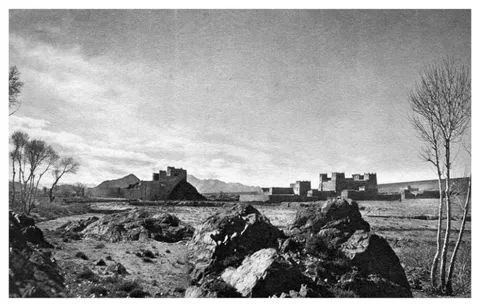
“London, Paris, Washington and Igharm Amazdar”: a village of a hundred houses that was the political, judicial and sacred centre of the Aït Atta.
Step 9 · Topic
Two-tier justice, without professional judges, protected by the sacred.
Step 10 · Topic
Between groups and between persons, ritual commitments (an animal's blood shed, milk shared) created protection, peace and chosen kinship.