Step 1 · Topic
Origins and expansion
A confederation that claims to have been born in the Saghro and spread, from the 16th to the 19th century, from the Drâa to the Tafilalt and up to the slopes of the Central Atlas.


Guided tours · 9 steps
From the documented origins to today: expansion, written customs, conquest, 1933, administration and memory. Each period says only what the sources establish.
Map of the Aït Atta expansion (after Dunn, 1973) — Wikimedia Commons, CC0
Step 1 · Topic
A confederation that claims to have been born in the Saghro and spread, from the 16th to the 19th century, from the Drâa to the Tafilalt and up to the slopes of the Central Atlas.
Step 2 · Topic
A document photographed in 1961: rations owed to the shurfa, fines in measures of barley, oaths at Timjraj.

Step 3 · Topic
Collections of rules, written in Arabic with Amazigh words, organised life in the fortified villages: houses, water, theft, marriage, oath.
Step 4 · Topic
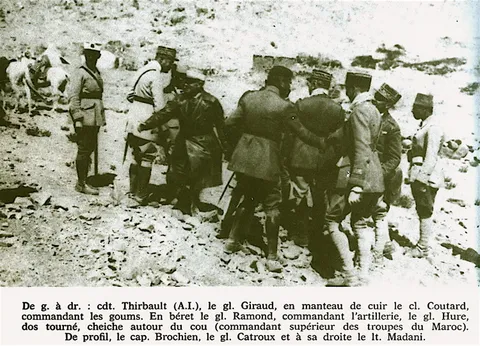
Who led the operations, who supported them, and why Aït Atta were found on both sides: what the sources read say, and what they do not allow us to assert.

Step 6 · Chapter
1933 – today — From the end of the fighting to commemoration

Step 7 · Topic
Customary law supervised by the Protectorate, then abolished at independence; rural communes instead of tribes.

Step 8 · Topic
In France, the cult of Bournazel; in Morocco, a battle that became an episode of the national struggle, and witnesses whose words are only beginning to be collected.
Step 9 · Dossier
Within less than two months, two sites were inaugurated around the Bougafer: at Ikniouen, a space for the memory of the resistance funded by Moroccan institutions; at Alnif, a cemetery restored by the French state, where goumiers among others are buried. This dossier keeps apart what the sources say, official discourse, criticism and the positions of local associations.