Step 1 · Topic
The Aït Ouahlim (Aït Wahlim)
One of the five “fifths” of the Aït Atta: the tribes of the Aït Zemro and the Aït Hasso, from the Todgha to the Draa.
Guided tours · Khoms of the Aït Ouahlim · 9 steps
One fifth of the Aït Atta, its groupings, its tribes and its documented figures.
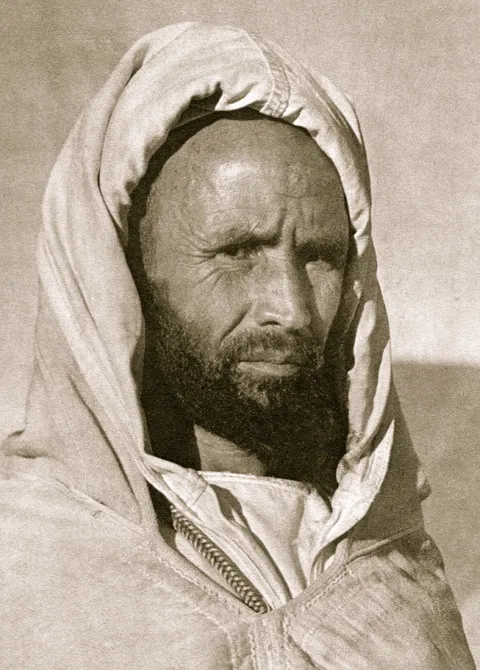
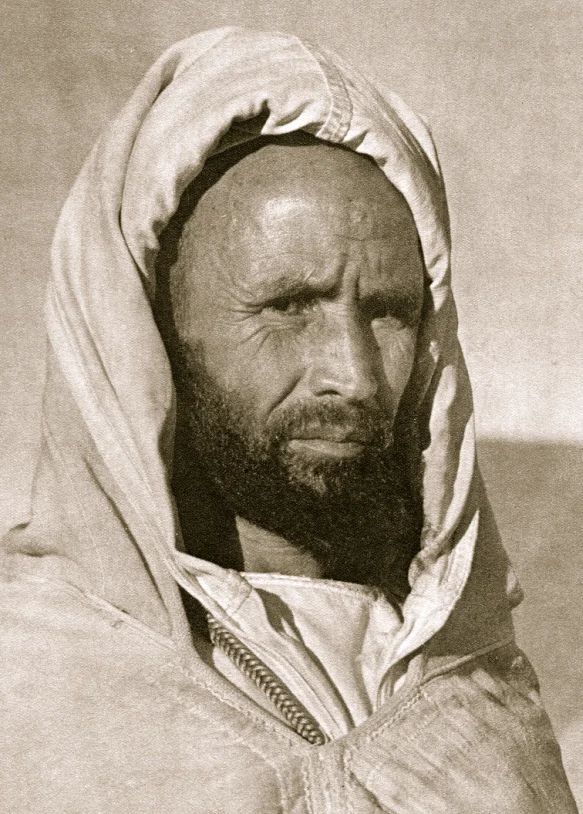
Hasso ou Ba Selem (Assou Oubasslam), portrait published by J. Robichez (1946) — J. Robichez, Maroc central (Arthaud, 1946) ; fichier fourni par le titulaire du projet, Publication autorisée par le titulaire du projet (déclaration du 8 novembre 2026)
Step 1 · Topic
One of the five “fifths” of the Aït Atta: the tribes of the Aït Zemro and the Aït Hasso, from the Todgha to the Draa.
Step 2 · Component
First of the two groupings of the khoms of the Aït Ouahlim in Beaurpère's table (1930), with four tribes: Aït Bou Iknifen, Aït Aïssa ou Brahim, Ilemchan and Ignaouen. Hart finds the “Ait Zimru” as one of the two sub-fifths of the Ait Wahlim, which supplied two of the six judges of the appeal court at Igherm Amazdar (1984, p. 11).
Step 3 · Component
Second grouping of the Aït Ouahlim in Beaurpère, with a single tribe, noted “Aït Kzad Ikhsan”, whose sections live in the Tafilalet, on the southern slope of the Saghro and at Tazarine. Spillmann makes it the third “third” of the Aït Ouahlim: almost all have property in the Draa, the Aït Bou Daoud are centred on Tazarine and the Aït Izzo on Taghbalt; they are close to the Aït Khebbach. Hart finds the Ait Hassu as a sub-fifth (1984, p. 11). In 1933, some Aït Hassou defended the Saghro while others served in the auxiliary harkas.
Step 4 · Component
Hart describes them as concentrated in the Saghro, with elements in the Draa, “in some respects the most noteworthy” of the Aït Atta clans; they consider themselves the major clan of the country (1984, pp. 21, 30). In the Saghro they own the storehouse qasbas of Miqquebbi and Igherm n'Ilemchan, where only guardians live (Beaurpère). Their collective pasture, the agudal n-Ilimshan south of the Tizi n'Ilisi pass, is shared with the Ihansalen according to a fixed calendar (Hart). Hart reports that once all the Aït Atta ganged up against them, in a war of “seven years”, a figure he considers suspect (p. 117). Assou Oubasslam and his brother Basso, of the Aït Bu Tghuratin lineage, were their leaders in 1930-1933; other Ilemchan, those of the Dadès, served the same year in the auxiliary harkas.
Step 5 · Component
The Imider valley is their zone of influence; Beaurpère notes that they took it from the Aït Ounir. Spillmann attributes to them a Maʿqil Arab origin, without proof, and reports that the Aït Khebbach are said to have entered the confederation under their sponsorship. Their notable Mohaddach, son of El Hajj Faska, was the Glaoui's man in the upper Dadès and the Todgha; in 1933 Aït Bou Iknifen fought in the auxiliary harkas, while other families of the same group were among the defenders of the Saghro.
Step 6 · Person
Chief of the Ilemchan (Aït Atta), principal leader of the resistance in the Saghro in 1933.
Step 7 · Person
Former amghar n-ufilla of the Aït Atta, one of the three notables of the Aït Ouahlim around 1930.
Step 8 · Person
Notable of the Aït Bou Iknifen, ally of the Glaoui in the upper Dadès and the Todgha from 1919.
Step 9 · Person
A woman of the Saghro whom local memory makes a figure of the Bougafer resistance (1933).